
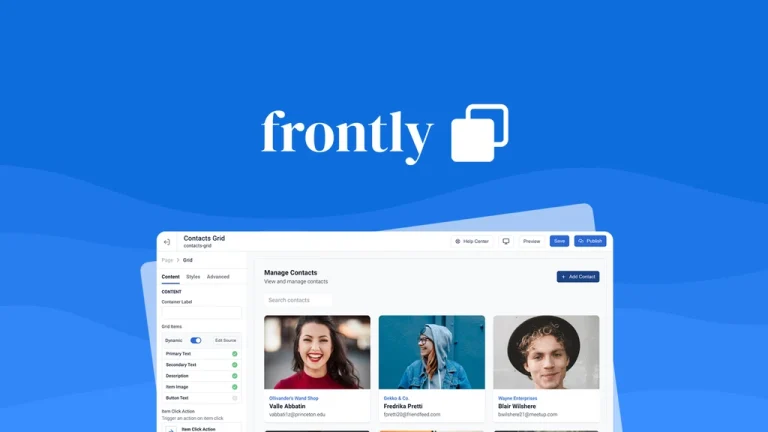
By 2027, Gartner predicts that over 65% of application development will be done using low-code/no-code platforms. This shift is driven by the growing need for agility, cost-efficiency, and democratization of software creation. Tools like Frontly are at the forefront of this transformation — especially for startups, agencies, and non-technical founders who need robust apps without hiring developers.
In this review, we’ll explore Frontly’s capabilities in depth. With over a decade of experience building scalable SaaS systems and internal tools, I’ve seen firsthand how traditional development can stall innovation. Frontly offers a compelling alternative.
It promises rapid deployment, AI-powered design, and real-time data interaction — all within a no-code environment. But how does it really perform? And is it worth the investment?
Let’s dive into a comprehensive analysis.
Frontly at a Glance: Key Highlights
Frontly is a cloud-based, AI-driven no-code app builder designed to convert structured data — primarily from Google Sheets — into dynamic, fully functional web applications. It drastically reduces the time, cost, and complexity of building tools like client portals, dashboards, and internal systems.
Whether you’re a founder testing a SaaS MVP or a consultant managing multiple client portals, Frontly removes the need for backend development, UI design, and hosting configuration.
Here’s a quick overview of what sets it apart:
- AI-Powered Layout Generation: Uses GPT-4 to create app templates with minimal input.
- Google Sheets as Backend: Instantly syncs spreadsheet data into your app.
- Custom Permissions: Tailor user roles for granular access control.
- Responsive UI: Drag-and-drop builder with full mobile responsiveness.
- Affordable Lifetime Deal: One-time payment via AppSumo for long-term use.
Why Frontly Stands Out in the No-Code Ecosystem
The no-code space is crowded with tools like Bubble, Adalo, and Glide. However, Frontly introduces a unique proposition: combining spreadsheet familiarity with AI-powered automation. For professionals used to managing data in Google Sheets, this is a game-changer.
Unlike Bubble, which requires a steep learning curve to master workflows and database schemas, Frontly simplifies the process. You connect your Sheet, run an AI prompt, and have a working prototype in minutes. This makes it ideal not only for MVPs, but also for operational tools like CRMs, reporting dashboards, and inventory systems.
What’s more, the platform’s backend is abstracted, so there’s no need to manage hosting or infrastructure. This eliminates common DevOps challenges and allows teams to focus purely on functionality and UX.
Deep Dive: Frontly’s Core Features
Google Sheets Integration
Frontly allows you to use Google Sheets as your app’s database. This is particularly beneficial for teams already managing operations, sales, or inventory through spreadsheets.
The real-time two-way sync ensures data updates reflect instantly across the app — ideal for client-facing portals or internal dashboards. This also reduces training time, since spreadsheet logic is already familiar to most users.
Use cases include:
- Sales teams tracking leads and KPIs
- Agencies managing client deliverables
- Operations teams monitoring inventory or logistics
AI-Powered App Generation
At the heart of Frontly is its GPT-4-driven AI feature that auto-generates app layouts. You simply describe the app in a few lines (e.g., “Create a sales performance dashboard”), and Frontly builds out pages, fields, and visual elements accordingly.
This eliminates the trial-and-error often seen in UI design, especially for non-designers. It also accelerates the prototyping process — crucial for MVPs and stakeholder demos. In testing, the AI-generated layouts required minimal tweaking for production use. This makes Frontly a practical choice when time-to-market is critical.
Custom User Roles & Permissions
Frontly supports detailed role management, allowing app creators to define what different users can view or edit. This is essential for multi-client environments, HR systems, or internal apps with hierarchical access.
For example, a sales dashboard can show team-wide metrics to managers while restricting individual data to reps. Likewise, a client portal can deliver tailored insights to each customer based on their login credentials. This level of control is usually found in enterprise-grade platforms — a major advantage at Frontly’s price point.
Visual Builder with Drag-and-Drop Interface
The interface is intuitive, even for non-technical users. You can drag elements like charts, tables, forms, and buttons onto your canvas. Each component is customizable — fonts, colors, logic, and layout.
The builder also supports conditional logic and dynamic data rendering. This enables advanced workflows such as:
- Conditional form validations
- Dynamic user dashboards based on login sessions
- Filtered views and role-specific data displays
All designs are natively responsive, ensuring a seamless experience across desktop and mobile devices.
Automation & Third-Party Integration
Frontly connects to tools like Zapier, Make (formerly Integromat), and via Webhooks. This allows you to trigger workflows based on app activity or data changes.
For example:
- Auto-send email when a form is submitted
- Trigger Slack notifications for new CRM entries
- Push app data into external databases or analytics tools
While the current integration set is limited compared to giants like Bubble, the essentials for automation and scale are in place.
Who Should Use Frontly?
Frontly’s versatility makes it suitable for a broad spectrum of professionals. Its sweet spot lies in operational tools, dashboards, and SaaS MVPs. Here’s who benefits the most:
- Startup Founders: Build and test MVPs rapidly without hiring developers.
- Agencies & Consultants: Deliver custom portals for clients with role-based access.
- Internal Teams: Replace spreadsheets with streamlined internal tools.
- Non-Technical Entrepreneurs: Bring business ideas to life without coding.
Practical Use Cases
- Client onboarding and service portals
- Sales performance dashboards with real-time KPIs
- Human resources tools for tracking employee data
- Inventory and order management systems
- Custom CRMs tailored to niche industries
Pricing Breakdown: AppSumo Lifetime Deal
Frontly’s one-time pricing model is a major draw, especially compared to subscription-heavy competitors. Here’s the deal structure:
| Tier | Price | Includes |
|---|---|---|
| Tier 1 | $59 | 1 App, 3 Admins, Unlimited End Users, 5K Monthly Views |
| Tier 2 | $118 | 3 Apps, 10 Admins, 15K Monthly Views |
| Tier 3 | $177 | 10 Apps, 30 Admins, 50K Monthly Views |
Every tier includes AI generation, full branding control, and Google Sheets integration. All purchases come with a 60-day money-back guarantee from AppSumo.
Frontly vs Other No-Code Platforms
| Feature | Frontly | Bubble | Adalo |
|---|---|---|---|
| AI Layout Generation | Yes (GPT-4) | No | No |
| Google Sheets Integration | Native | Via Plugin | Limited |
| Lifetime Deal | Yes (AppSumo) | No | No |
| Visual Builder | Yes | Yes | Yes |
| Custom User Roles | Yes | Yes | Limited |
Expert Insights: Trends, Risks, and Recommendations
The rise of AI in no-code platforms represents a paradigm shift in software development. Tools like Frontly are blurring the lines between developer and user — empowering business teams to build tools once reserved for engineering departments.
However, there are trade-offs.
While Frontly excels in speed and simplicity, it’s not meant for highly complex, logic-heavy apps. Developers might find its abstraction limiting in very technical use cases.
Still, for 80% of operational tools — especially those built on structured data — Frontly delivers exceptional value. Expect future releases to include more integrations, mobile app capabilities, and database flexibility.
FAQs
Can I use Frontly without any coding background?
Yes, Frontly is designed for non-technical users. Its drag-and-drop interface, AI layout generation, and spreadsheet backend make it easy for anyone to create powerful apps without writing code.
Is the AI-generated layout customizable?
Absolutely. You can edit, rearrange, and style every element after the AI generates your initial layout. This allows you to maintain creative control while benefiting from a fast starting point.
Does Frontly support collaboration across teams?
Yes, admin and view-only roles can be assigned to different team members. This makes it ideal for teams working on internal tools or client-facing apps with tiered permissions.
How scalable is Frontly for growing businesses?
Frontly scales well for small to mid-sized apps. However, for enterprise-grade applications with high concurrency or custom backend logic, traditional or hybrid solutions may be more suitable.
How secure is my data in Frontly?
Data is hosted securely with SSL encryption and access control. Since it relies on Google Sheets for backend data, your Google account permissions also play a critical role in data security.
Conclusion
Frontly is a standout solution in the no-code space — especially for those who value speed, simplicity, and affordability. By leveraging AI and spreadsheet logic, it bridges the gap between idea and execution.
For startups, consultants, and internal teams, the ROI is immediate.
You get a scalable, customizable app without the development overhead. While it’s not a fit for every use case, it excels in operational tools, dashboards, and MVP launches. Looking ahead, its roadmap suggests stronger integrations and feature depth. For now, the AppSumo lifetime deal is a low-risk, high-reward opportunity.

